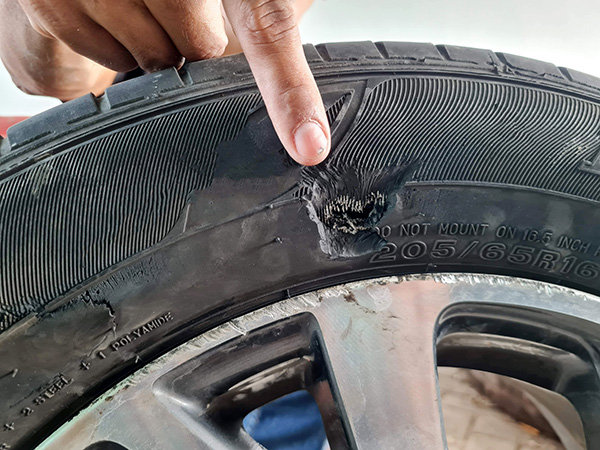
A sidewall puncture is the kind of tire problem that makes you pause. The hole can look small enough to fix, and you may even know someone who says they patched it years ago and it was fine. The problem is, sidewall repairs fail in ways that are hard to predict.
If you want to avoid buying a tire you don't need, and also avoid a sketchy repair that quits at the worst moment, it helps to understand why sidewalls are a different story.
Why Sidewalls Are Built Differently Than Treads
The tread area is thick, reinforced, and designed to take impacts straight-on. The sidewall is built to flex thousands of times per mile while supporting the vehicle’s weight and absorbing bumps. That flex is normal, but it is also exactly what works against most repairs.
If you are trying to judge whether a sidewall puncture is already risky, a few clues tend to show up early:
- A bulge or ripple in the sidewall, even a small one
- Repeated air loss after topping off
- A puncture close to the shoulder where the tread curves down
- Signs the tire was driven low, like scuffed rubber on the sidewall
None of these automatically means disaster, but they are strong signs the tire’s structure may already be compromised.
1. Sidewalls Flex Constantly And Repairs Hate Flex
A repair needs stability to last. The tread area is relatively stable compared to a sidewall, which bends, twists, and stretches as the tire rolls. Every rotation puts the repair through a flex cycle, then another, then another, and that is where the bond can start to lift or the plug material can begin to work loose.
Even a well-done repair can struggle if it is forced to live in the most flexible part of the tire. The longer and faster you drive, the more heat and movement you add, and both of those increase the chance that the repair slowly loses its seal.
2. Sidewall Cords Can Be Cut Even When The Hole Looks Tiny
A nail hole can look clean from the outside, but the real issue is what it did inside the tire. Sidewalls contain reinforcing cords that give the tire its shape and strength. If those cords are cut, torn, or separated, sealing the air does not restore the strength.
That is why sidewall punctures are treated differently from tread punctures. A tread puncture can sometimes be repaired because the structure and thickness in that zone can tolerate a patch-and-plug repair. A sidewall puncture may leave the tire weaker even if it holds air, and weakness is what leads to bubbles, sudden ruptures, and blowouts.
3. Heat And Low Pressure Multiply The Damage
Sidewall problems get worse fast when the tire runs even slightly underinflated. Low pressure makes the sidewall flex more, which creates more heat. Heat softens rubber and stresses the internal layers, and once that starts, the tire can be damaged in a way you cannot see from the outside.
The timeline often looks like this: the puncture leaks slowly, pressure drops a bit, the sidewall flexes harder during normal driving, heat builds, and internal wear accelerates. After that, the tire may develop a bulge or start leaking again, even if it was “repaired.” We see this most often when someone drives a short distance on a low tire, thinking it is no big deal, then the tire never behaves the same again.
4. Repairs Often Seal Air, But Not Strength
A lot of quick fixes focus on stopping the leak, which is understandable. But stopping air loss is only one part of the problem. The tire still has to carry weight, corner, brake, and handle potholes, and that takes structural integrity.
Sidewall repairs can sometimes hold air for a while, which is what makes them tempting. The issue is that they do not rebuild the internal layers or restore the cords that were damaged. Over time, the weakened area can start to separate internally. That separation may show up as a bubble, a vibration that seems to come out of nowhere, or a failure that happens without much warning.
5. The Shoulder Zone Creates A Gray Area That Fails Later
Many punctures that people call sidewall punctures are actually near the shoulder, where the tread curves down into the sidewall. This area is tricky because it flexes more than the center tread and sees heavy stress during cornering. A repair that might be acceptable in the center of the tread can be questionable once it moves closer to that transition zone.
This is where a careful inspection matters. The exact location, the angle of the puncture, and the condition of the tire's interior will determine whether a safe repair is possible. If the puncture is too close to the shoulder or into the sidewall, replacement is usually the only option that keeps the car stable and predictable at speed.
Get Tire Repair in Reading, PA with Auto Pro
We can inspect the puncture from the inside and outside, check for cord damage, and tell you clearly whether a safe repair is possible or if replacement is the smarter move. We’ll also help you avoid tread-depth mismatches that can affect handling and traction.
Call Auto Pro in Reading, PA, to schedule a tire inspection and get a straight answer before a questionable sidewall repair becomes a roadside problem.